Right to Life and Environmental Protection - Expanding Article 21
Introduction
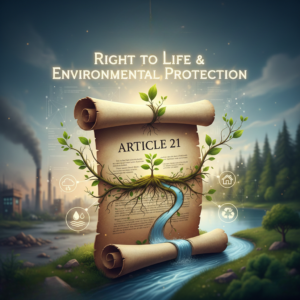
Few constitutional provisions in India have demonstrated the dynamism, moral force, and transformative potential of Article 21 of the Constitution. Originally framed as a narrow guarantee against arbitrary deprivation of life and personal liberty, Article 21 has evolved into a powerful source of substantive rights that shape everyday governance. Among its most consequential expansions is the recognition that environmental protection is inseparable from the right to life.
This expansion reflects a simple yet profound insight: life cannot be lived with dignity in a polluted, degraded, or ecologically unstable environment. Clean air, safe drinking water, fertile land, and a stable climate are not luxuries or policy preferences; they are preconditions for human survival and well-being. As India grapples with air pollution crises, water scarcity, industrial contamination, and deforestation, constitutional environmentalism has emerged as a crucial legal response.
The Supreme Court of India has played a decisive role in articulating this connection. Through creative interpretation, Article 21 has been read to include the right to a clean and healthy environment, the right to health, and the right to livelihood where environmental degradation threatens survival. This judicial expansion has reshaped environmental law, strengthened citizen remedies, and influenced policy debates. Understanding this evolution is essential for appreciating how constitutional law can respond to contemporary ecological challenges.
Legal Background: Article 21 Explained
Article 21 of the Constitution of India provides: “No person shall be deprived of his life or personal liberty except according to procedure established by law.” At the time of its adoption, this provision was interpreted conservatively, focusing on procedural safeguards rather than substantive content. Early jurisprudence treated “life” as mere physical existence, leaving questions of quality, dignity, and environment largely outside constitutional scrutiny.
This narrow understanding began to change in the late 1970s, when the Supreme Court adopted a more purposive and humanistic approach to fundamental rights. Article 21 was reinterpreted to include not only protection from unlawful deprivation but also affirmative conditions necessary for a meaningful life. The Court emphasized that “life” under Article 21 is not animal existence but a life with dignity, health, and minimum material conditions.
Once dignity became central to Article 21, environmental concerns naturally followed. Pollution, ecological degradation, and unsafe living conditions directly undermine health, livelihood, and human dignity. Environmental harm often affects vulnerable communities disproportionately, raising issues of equality and social justice. Against this backdrop, Article 21 became the constitutional foundation for integrating environmental protection into the right to life.
Judicial Expansion: Key Indian Jurisprudence
The Supreme Court’s environmental jurisprudence under Article 21 developed incrementally through public interest litigation (PIL), allowing citizens and civil-society groups to approach the Court on behalf of affected communities and ecosystems.
One of the earliest and most influential cases was Rural Litigation and Entitlement Kendra v. State of Uttar Pradesh (1985). The Court addressed unregulated limestone mining in the Doon Valley, which caused ecological damage and threatened local livelihoods. Recognizing the link between environmental degradation and the right to life, the Court ordered the closure of certain mines, prioritizing ecological balance over short-term economic gains.
In Subhash Kumar v. State of Bihar (1991), the Court explicitly stated that the right to life under Article 21 includes the right to enjoy pollution-free water and air. This case marked a clear doctrinal shift, firmly anchoring environmental quality within constitutional protection.
The principle was further elaborated in Virender Gaur v. State of Haryana (1995), where the Court held that environmental sanitation and hygiene are integral to the right to life. The judgment emphasized that environmental protection is not merely a statutory obligation but a constitutional mandate.
Perhaps the most comprehensive articulation came in M.C. Mehta v. Union of India (1986–1997 series), a landmark set of cases addressing industrial pollution, vehicular emissions, and river contamination. In the Oleum Gas Leak case (1987), the Court evolved the principle of absolute liability for hazardous industries, strengthening environmental accountability. In subsequent orders, the Court linked public health, environmental safety, and Article 21, directing far-reaching regulatory reforms.
In Indian Council for Enviro-Legal Action v. Union of India (1996), the Court applied the “polluter pays” principle, holding that industries responsible for environmental harm must bear the cost of remediation. The judgment reinforced that environmental damage violates Article 21 rights of affected communities.
Later, in A.P. Pollution Control Board v. Prof. M.V. Nayudu (1999), the Court highlighted the precautionary principle, emphasizing that lack of scientific certainty should not delay measures to prevent environmental harm. This approach aligned Indian constitutional law with evolving international environmental norms.
Across these cases, courts have relied on principles of sustainable development, intergenerational equity, precaution, and polluter pays. Article 21 has served as the constitutional bridge connecting these principles to enforceable rights, enabling courts to issue binding directions to protect ecosystems and public health.
Comparative and International Perspective
India’s constitutional approach resonates with global trends recognizing environmental protection as a fundamental right. Several jurisdictions and international bodies have moved toward explicit or implicit recognition of environmental rights.
Ecuador offers one of the most radical models. Its 2008 Constitution recognizes the “rights of nature,” granting ecosystems legal standing independent of human interests. Courts in Ecuador have enforced these rights to halt environmentally destructive activities, reframing environmental protection as a matter of constitutional justice rather than regulatory discretion.
In Europe, the European Court of Human Rights has interpreted the right to private and family life under Article 8 of the European Convention to include protection against severe environmental harm. Cases involving industrial pollution and hazardous waste have held states accountable for failing to safeguard environmental conditions affecting human health.
At the international level, the United Nations Human Rights Council in 2021 recognized the right to a clean, healthy, and sustainable environment as a human right. This recognition, while not directly binding, reflects growing global consensus. Instruments such as the Stockholm Declaration (1972) and Rio Declaration (1992) have long emphasized the link between human rights and environmental protection.
India’s Article 21 jurisprudence aligns closely with these developments. By constitutional interpretation rather than formal amendment, Indian courts have integrated international environmental principles into domestic law, reinforcing India’s role in the global environmental rights movement.
Policy and Implementation Challenges
Despite doctrinal advances, translating Article 21’s environmental guarantees into ground-level outcomes remains challenging. Judicial recognition alone cannot resolve systemic enforcement deficits.
Air pollution illustrates this gap vividly. Despite repeated Supreme Court interventions, cities like Delhi continue to experience hazardous air quality. Fragmented regulatory authority, weak enforcement capacity, and political resistance undermine compliance with judicial directions.
Industrial contamination presents another challenge. Legacy pollution from chemical plants and mining operations continues to affect groundwater and agricultural land. Litigation under Article 21 often results in compensation orders, but remediation is slow and monitoring inadequate.
Deforestation and infrastructure expansion further complicate enforcement. Courts must balance environmental protection with development imperatives, often in the absence of clear statutory standards or reliable environmental data. Ambiguity in environmental impact assessments and limited public participation weaken accountability.
Additionally, over-reliance on courts risks institutional overload. Judicial orders may lack follow-up mechanisms, and frequent judicial intervention can blur lines between adjudication and administration. These challenges highlight the limits of judicial expansion without complementary legislative and executive action.
Recommendations: Law and Policy Reforms
To strengthen environmental protection under Article 21, coordinated reforms across institutions are essential.
First, Parliament should consider statutory recognition of the right to a healthy environment, providing clearer standards and remedies aligned with Article 21 jurisprudence.
Second, binding national environmental quality standards for air, water, and soil should be regularly updated and strictly enforced, reducing reliance on ad hoc litigation.
Third, environmental data transparency must improve. Real-time pollution monitoring and public access to environmental information would empower communities and regulators alike.
Fourth, specialized environmental adjudication should be strengthened. Enhancing the capacity and independence of the National Green Tribunal would improve consistency and enforcement.
Fifth, community participation in environmental decision-making should be institutionalized through mandatory public consultations and grievance redress mechanisms.
Sixth, corporate environmental accountability should be reinforced through stricter disclosure norms, director liability for environmental violations, and effective remediation bonds.
Seventh, environmental education and civic awareness initiatives should be expanded, fostering a culture of constitutional environmentalism beyond courts.
Finally, inter-agency coordination between environmental regulators, urban authorities, and public health institutions must improve to address complex, cross-sectoral harms.
Conclusion
The expansion of Article 21 to include environmental protection represents one of the most significant achievements of Indian constitutional jurisprudence. By recognizing that a clean and healthy environment is integral to the right to life, courts have elevated environmental concerns from policy choices to matters of constitutional obligation. This evolution has empowered citizens, shaped regulatory frameworks, and aligned India with global human-rights trends.
Yet constitutional recognition is only the first step. The promise of Article 21 will be realized fully only when judicial principles are translated into effective governance, robust enforcement, and participatory decision-making. As environmental crises intensify, strengthening the constitutional foundation of environmental protection is not merely desirable but essential for safeguarding present and future generations.
Disclaimer - The blog is for informational purpose and does not constitute legal advice, consult a qualified lawyer for case specific guidance.


Professional services and legal support firm dedicated to simplifying paperwork, compliance and day-to-day documentation.
Quick Links
- About Us
- Professional Services
- Legal Services
- Contact
Contact Us
- +91 xxxxx xxxxx
- contact@shreesudarshan.com
Disclaimer: Legal services are provided in accordance with applicable laws and regulations. Court appearances and specific legal opinions are handled by registered advocates; Shree Sudarshan does not claim to be a law firm unless duly registered as such in the relevant jurisdiction.
© 2025 Shree Sudarshan. All rights reserved
- Privacy Policy
- Terms of Services