Evolution of Corporate Governance in India: A Post-Satyam Scam Perspective
Introduction
Corporate governance in India is often described in two phases: before and after the Satyam Computer Services scandal of 2009. While governance frameworks existed earlier, Satyam exposed how formal compliance could coexist with deep-seated failures in oversight, ethics, and accountability. The episode shook investor confidence, embarrassed regulators, and forced a national reckoning on how Indian corporations were governed.
Satyam mattered not merely because of the scale of fraud, but because it involved a widely admired, globally listed firm that was considered a symbol of India’s IT success. Its collapse challenged assumptions that market reputation, reputed auditors, and independent directors were sufficient safeguards. The scandal also arrived at a time when India was seeking greater integration with global capital markets, making governance credibility economically critical.
This article analyses the evolution of corporate governance in India from a post-Satyam perspective. It reviews the weaknesses the scandal exposed, examines the regulatory and institutional reforms that followed, evaluates market responses, and assesses ongoing challenges. The central argument is that while India’s governance framework has strengthened significantly since 2009, effectiveness now depends less on rule-making and more on enforcement quality, board capability, and ethical leadership.
The Satyam scandal: brief recap
In January 2009, Satyam Computer Services’ founder-chairman Ramalinga Raju confessed to having falsified the company’s accounts for several years. He admitted to overstating cash balances by over ₹5,000 crore, manipulating revenues, and understating liabilities (Raju, 2009). The fraud represented nearly one-third of the company’s balance sheet and had gone undetected by auditors, analysts, and the board.
The revelation triggered an immediate collapse in Satyam’s share price, wiped out billions in market value, and raised fears about the reliability of Indian corporate disclosures. International investors questioned whether Satyam was an aberration or a symptom of systemic governance weaknesses. The scandal also highlighted the dangers of promoter dominance in Indian companies, where founders often wield significant control despite dispersed shareholding.
The government intervened swiftly, dissolving Satyam’s board and facilitating its sale to Tech Mahindra to preserve jobs and client contracts. While this limited systemic damage, the reputational shock endured. For regulators and policy makers, Satyam became a watershed moment that demanded structural reform rather than incremental adjustments.
State of corporate governance pre-Satyam
Before Satyam, India’s corporate governance framework was shaped largely by Clause 49 of the Listing Agreement, introduced by SEBI in the early 2000s. Clause 49 mandated independent directors, audit committees, and enhanced disclosures. On paper, these norms aligned broadly with global standards (SEBI, 2004). In practice, compliance was often procedural rather than substantive.
Boards were frequently dominated by promoters, with independent directors lacking information, time, or incentives to challenge management. Auditor independence was compromised by long tenures and the provision of lucrative non-audit services. Related-party transactions, especially within business groups, were inadequately scrutinised and poorly disclosed.
Internal controls and risk management systems were underdeveloped, particularly in fast-growing companies. Enforcement was fragmented, with limited coordination between SEBI, the Ministry of Corporate Affairs (MCA), and investigative agencies. Penalties for governance failures were modest, reducing deterrence. Satyam exposed how these weaknesses could coexist within a seemingly compliant governance structure, revealing a gap between form and substance.
Regulatory and institutional reforms after Satyam
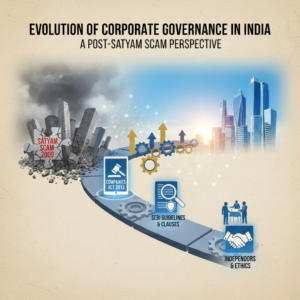
The post-Satyam period witnessed the most comprehensive overhaul of India’s corporate governance regime since liberalisation. Reforms were both legislative and regulatory, aimed at strengthening boards, audits, disclosures, and enforcement.
SEBI played a central role by tightening listing requirements and disclosure standards. Clause 49 was progressively strengthened, culminating in the SEBI (Listing Obligations and Disclosure Requirements) Regulations, 2015. The LODR regulations consolidated and modernised governance norms, imposing stricter requirements on board composition, audit committees, related-party transactions, and continuous disclosures (SEBI, 2015). Listed companies were required to have at least one woman director, enhancing board diversity.
A landmark reform was the enactment of the Companies Act, 2013, which replaced the 1956 legislation. The Act significantly expanded directors’ duties under Section 166, explicitly requiring directors to act in good faith, exercise due care, and protect stakeholder interests (MCA, 2013). It mandated independent directors for certain classes of companies, prescribed their roles through Schedule IV, and introduced mandatory board evaluation.
The Act also strengthened audit quality. Provisions on auditor rotation under Section 139 limited long auditor tenures, while restrictions on non-audit services aimed to protect independence. Enhanced internal financial controls and mandatory internal audits for specified companies improved risk oversight. The introduction of corporate social responsibility obligations under Section 135 reflected a broader conception of corporate accountability.
Institutionally, enforcement capacity was bolstered. The Serious Fraud Investigation Office (SFIO) was given statutory backing and greater investigative powers. Penalties for fraud, including imprisonment under Section 447, increased the personal risk for promoters and executives. SEBI also enhanced its surveillance and enforcement mechanisms, using data analytics to detect market abuse.
The role of audit committees and independent directors evolved in parallel. Audit committees were given expanded powers over auditor appointments, related-party approvals, and financial reporting. Independent directors, while facing higher liability, gained clearer authority and protection mechanisms, including directors’ and officers’ insurance.
Collectively, these reforms represented a shift from disclosure-centric governance to accountability-oriented governance. However, their effectiveness depended on consistent enforcement and cultural change within boards and management.
Market and corporate responses
Indian corporates responded to post-Satyam reforms by professionalising board processes and strengthening compliance infrastructure. Many large companies expanded board agendas to include risk management, cybersecurity, and succession planning. Internal audit functions were upgraded, often reporting directly to audit committees rather than management.
Institutional investors became more active stewards. Domestic mutual funds and insurance companies, encouraged by stewardship codes, began scrutinising governance practices and voting against management when concerns arose (SEBI, 2020). Proxy advisory firms gained influence, shaping shareholder voting outcomes on executive pay, board appointments, and related-party transactions.
Audit firms invested in forensic capabilities and tightened engagement acceptance standards. High-profile enforcement actions against auditors reinforced expectations of professional scepticism. Cross-border investors increasingly compared Indian governance practices with global benchmarks, incentivising convergence.
Despite these improvements, responses varied by company size. Large listed firms generally adapted well, while smaller companies struggled with compliance costs and expertise gaps. The market thus rewarded governance quality, but unevenly.
Persistent challenges and unintended consequences
Notwithstanding progress, several governance challenges persist. Board effectiveness remains uneven, with some independent directors still constrained by information asymmetry and time limitations. Promoter influence continues to shape decision-making in many family-controlled firms, particularly within complex group structures.
Enforcement capacity, while improved, faces resource constraints and procedural delays. High compliance costs have also encouraged a box-ticking approach, where formal adherence substitutes for genuine oversight. Some experienced professionals have been reluctant to accept independent directorships due to liability concerns.
Related-party transactions remain a sensitive area, especially in conglomerates where economic dependence complicates independence. These challenges suggest that regulation alone cannot ensure governance quality without sustained cultural change.
Emerging trends and future directions
Looking ahead, corporate governance in India is increasingly shaped by ESG considerations. Regulators and investors now expect boards to oversee sustainability risks, human capital management, and climate disclosures. SEBI’s Business Responsibility and Sustainability Reporting framework reflects this shift (SEBI, 2021).
Digital reporting and data analytics are enhancing transparency and regulatory supervision. Technology-enabled audits and continuous disclosures reduce information asymmetry. There is also greater emphasis on stakeholder governance, recognising employees, communities, and creditors alongside shareholders.
International convergence is likely to continue as Indian firms access global capital. This will increase expectations around board independence, audit quality, and ethical conduct. The post-Satyam trajectory suggests that governance evolution is ongoing rather than complete.
Recommendations
- Regulators should prioritise consistent, timely enforcement over additional rule-making.
- Boards must invest in director education and information systems to improve oversight quality.
- Independent directors should be selected for competence and courage, not symbolic compliance.
- Audit committees should deepen engagement with internal and forensic audit functions.
- Institutional investors must exercise stewardship responsibilities actively and transparently.
- Companies should integrate ESG risks into mainstream governance processes.
- Enforcement agencies should enhance coordination and technological capacity.
Conclusion
The Satyam scandal transformed corporate governance in India by exposing the limits of formal compliance and triggering far-reaching reforms. Over the past decade, India has built a robust governance architecture aligned with global standards. Yet governance quality ultimately depends on how rules are interpreted, enforced, and internalised by corporate leaders. The post-Satyam experience demonstrates that strong laws are necessary but insufficient; ethical leadership, vigilant boards, and engaged investors remain indispensable. As India’s economy grows and globalises, sustaining trust will require continuous governance evolution.
Disclaimer - The blog is for informational purpose and does not constitute legal advice, consult a qualified lawyer for case specific guidance.


Professional services and legal support firm dedicated to simplifying paperwork, compliance and day-to-day documentation.
Quick Links
- About Us
- Professional Services
- Legal Services
- Contact
Contact Us
- +91 xxxxx xxxxx
- contact@shreesudarshan.com
Disclaimer: Legal services are provided in accordance with applicable laws and regulations. Court appearances and specific legal opinions are handled by registered advocates; Shree Sudarshan does not claim to be a law firm unless duly registered as such in the relevant jurisdiction.
© 2025 Shree Sudarshan. All rights reserved
- Privacy Policy
- Terms of Services