Judicial Independence in India -Challenges and Reforms
Introduction
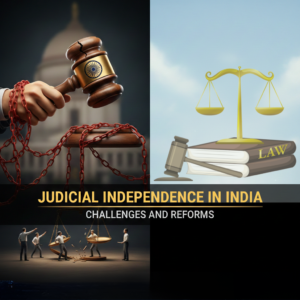
Judicial independence stands at the heart of India’s constitutional democracy. It ensures that courts can decide disputes fairly, protect fundamental rights, and act as a check on the excesses of power. Without an independent judiciary, constitutional guarantees risk becoming symbolic promises rather than enforceable rights. In a diverse and unequal society such as India’s, where citizens frequently rely on courts to protect liberty, property, and dignity, judicial autonomy is not a luxury but a necessity.
Over the decades, India’s judiciary has developed a reputation for assertiveness and innovation, particularly in constitutional interpretation. Yet this independence has never been absolute or uncontested. Concerns about appointments, accountability, executive influence, judicial delays, and public confidence continue to provoke debate. Recent controversies around judicial transfers, mounting vacancies, and calls for reform have intensified scrutiny of how independence is structured and sustained in practice.
This article examines judicial independence in India through a constitutional, institutional, and policy lens. It traces historical foundations, identifies contemporary challenges, evaluates reforms and judicial responses, and offers practical recommendations. The goal is to present a balanced assessment that recognises achievements while addressing structural weaknesses that threaten the judiciary’s credibility and effectiveness.
Historical and Constitutional Background
India inherited its judicial system from the colonial era, where courts functioned largely as instruments of imperial governance. Although British courts introduced procedural regularity and rule-based adjudication, they lacked independence from executive authority. This experience shaped the framers’ determination to insulate the judiciary from political pressure after Independence.
The Constitution of India embeds judicial independence through multiple provisions. Articles 124 and 217 establish security of tenure for Supreme Court and High Court judges, permitting removal only through impeachment by Parliament on grounds of proved misbehaviour or incapacity. Articles 125 and 221 safeguard judicial salaries by charging them to the Consolidated Fund, preventing executive manipulation. Article 50, part of the Directive Principles, calls for separation of the judiciary from the executive in the public services of the State.
In the early post-Independence period, judicial independence evolved cautiously. The executive initially exercised significant influence over appointments and transfers. However, constitutional adjudication during the 1960s and 1970s, particularly in fundamental rights cases, placed the judiciary in tension with political authority. The experience of the Emergency (1975–77), when civil liberties were curtailed and judicial resistance faltered, reinforced the need for institutional safeguards. Subsequent decades witnessed a jurisprudential shift toward strengthening autonomy, culminating in the development of the collegium system for judicial appointments.
Key Contemporary Challenges
Appointment and Accountability: Collegium versus NJAC
The process of appointing judges lies at the core of judicial independence debates. The collegium system, evolved through Supreme Court judgments, vests appointment power primarily in senior judges. Supporters argue that it shields the judiciary from executive interference. Critics contend that it lacks transparency, clear criteria, and external accountability.
The attempt to replace the collegium through the National Judicial Appointments Commission (NJAC) reflected broader concerns about opacity. Its invalidation by the Supreme Court reaffirmed judicial primacy but did not resolve underlying governance issues. The continuing absence of a formal, transparent appointments framework fuels perceptions of arbitrariness and elitism, potentially undermining institutional legitimacy.
Executive Interference and Judicial Transfers
Judicial independence can be compromised subtly through transfers and post-retirement appointments. While transfers are constitutionally permitted, frequent or unexplained movements of High Court judges raise concerns about punitive or strategic motivations. Similarly, appointments of retired judges to executive or quasi-executive positions may create perceptions of influence, even when no impropriety exists.
Such practices affect not only actual independence but also its appearance. In constitutional systems, perception matters deeply; public confidence depends on visible separation between adjudication and political authority.
Judicial Delays and Vacancies
India’s judiciary faces chronic delays and mounting arrears. According to data from the National Judicial Data Grid, millions of cases remain pending across courts [1]. Vacancies in High Courts and subordinate courts exacerbate the problem, increasing workloads and reducing the quality of deliberation.
Although delays do not directly negate independence, they weaken judicial authority and effectiveness. When justice is excessively delayed, executive and administrative discretion often fills the void, shifting power away from courts.
Financial and Administrative Independence
While judicial salaries are constitutionally protected, administrative and infrastructural dependence persists. Court budgets are often controlled by executive departments, limiting flexibility in staffing, technology, and infrastructure development. Subordinate courts, in particular, face resource constraints that affect independence at the grassroots level.
True independence requires not only decisional autonomy but also administrative capacity. Without control over basic resources, courts struggle to function efficiently and assert authority.
Perception and Public Trust
Public trust in the judiciary has become increasingly fragile. Allegations of impropriety, internal disagreements aired publicly, and inconsistent standards of accountability contribute to scepticism. Media scrutiny and social media amplification intensify these challenges.
Independence ultimately rests on credibility. If courts are perceived as opaque, biased, or disconnected, their constitutional role is weakened, regardless of formal safeguards.
Recent Reforms, Judicial Responses and Institutional Innovations
In response to these challenges, the judiciary and state institutions have undertaken several reforms. Judicial pronouncements have clarified ethical expectations and reinforced constitutional boundaries. Administrative innovations have sought to modernise court functioning and enhance transparency.
The Supreme Court has introduced procedures to disclose collegium resolutions, offering limited insight into appointment decisions. Although far from comprehensive transparency, these steps represent incremental progress. Judicial codes of conduct and in-house mechanisms for addressing complaints aim to balance independence with accountability.
Digitisation initiatives, including e-filing systems and virtual hearings, expanded significantly during the COVID-19 pandemic. These measures improved access and continuity, demonstrating institutional adaptability. Case management reforms and data-driven monitoring through the National Judicial Data Grid have enabled better oversight of pendency trends.
At the High Court and state levels, experiments with specialised benches, alternative dispute resolution mechanisms, and performance benchmarks have sought to reduce delays. The creation of the National Judicial Infrastructure Authority of India, proposed to centralise planning and funding, reflects recognition of administrative independence as a reform priority.
Despite these efforts, implementation remains uneven. Technological gains coexist with persistent vacancies and inconsistent administrative capacity. Reforms have improved efficiency but have not fundamentally resolved structural concerns around appointments and accountability.
Case Studies / Landmark Judgments
Judicial independence in India has been shaped by landmark constitutional decisions. The First Judges Case (1981) initially favoured executive primacy in appointments, reflecting institutional caution. This position was reversed in the Second Judges Case (1993), which established judicial primacy through the collegium system, redefining independence as insulation from political control.
The Third Judges Case (1998) clarified collegium composition and procedure, reinforcing collective decision-making among senior judges. More recently, the Supreme Court’s decision striking down the NJAC (2015) reaffirmed the basic structure doctrine, holding that judicial independence formed part of the Constitution’s unalterable core.
Beyond appointments, episodes involving attempted impeachments and controversial transfers have tested institutional resilience. These cases illustrate the judiciary’s role in defending autonomy while revealing tensions between accountability, transparency, and self-regulation.
Recommendations and Way Forward
Strengthening judicial independence requires balanced reform rather than absolutist positions. Independence and accountability must reinforce, not undermine, each other. Several practical measures can advance this goal:
Establish a transparent appointments framework with published criteria, timelines, and reasoned outcomes, while preserving judicial primacy.
Create an independent secretariat to support the collegium with research, data, and administrative capacity.
Institutionalise cooling-off periods for post-retirement appointments to reduce perceptions of executive influence.
Provide courts with greater control over budgets and infrastructure planning through statutory mechanisms.
Accelerate filling of vacancies through coordinated timelines and accountability for delays.
Strengthen ethical standards through clear codes, disclosure norms, and credible internal complaint processes.
Expand judicial training in administration, technology, and ethics to enhance institutional capacity.
These reforms require cooperation among the judiciary, executive, legislature, and civil society. Incremental change, grounded in constitutional values, offers the most sustainable path forward.
Conclusion
Judicial independence in India remains both a constitutional promise and an ongoing project. The judiciary has played a transformative role in protecting rights and maintaining democratic balance, yet structural and perceptual challenges persist. Independence cannot be preserved through isolation alone; it must be supported by transparency, resources, and public trust.
As India confronts complex social, economic, and political pressures, an independent and effective judiciary is indispensable. Reforms that strengthen autonomy while enhancing accountability can renew confidence in the institution. Ultimately, judicial independence is not solely about judges or courts; it is about safeguarding the constitutional order and ensuring that justice remains accessible, impartial, and credible for all.
Disclaimer - The blog is for informational purpose and does not constitute legal advice, consult a qualified lawyer for case specific guidance.


Professional services and legal support firm dedicated to simplifying paperwork, compliance and day-to-day documentation.
Quick Links
- About Us
- Professional Services
- Legal Services
- Contact
Contact Us
- +91 xxxxx xxxxx
- contact@shreesudarshan.com
Disclaimer: Legal services are provided in accordance with applicable laws and regulations. Court appearances and specific legal opinions are handled by registered advocates; Shree Sudarshan does not claim to be a law firm unless duly registered as such in the relevant jurisdiction.
© 2025 Shree Sudarshan. All rights reserved
- Privacy Policy
- Terms of Services